
Surface Finishing
Surface finishing is the process of modifying a surface to improve specific properties, such as corrosion resistance, durability, adhesion, or appearance.
We offer a wide range of surface finishes for CNC parts to meet your specific aesthetic and functional needs. Here’s common surface finishing processes:
- Anodizing
- Sandblasting
- Powder Coating
- Electroplating
- Heat Treatment
- Brushing
- Polishing
- Passivation
- Black Oxide
- Deburring
Anodizing
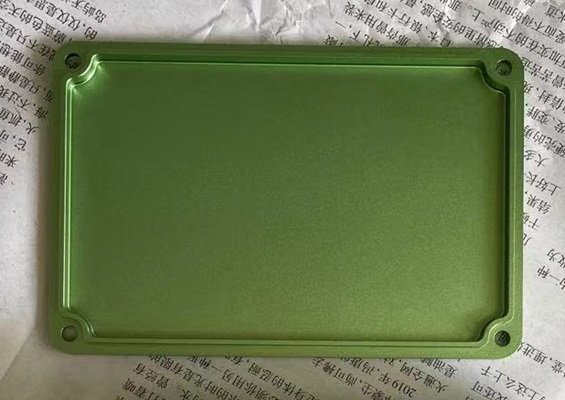
Anodizing mainly oxidizes aluminum products to give them more colors and achieve decorative purposes. It can also be hardened to make the product surface stronger and more corrosion-resistant. Anodized aluminum is UV-resistant, wear-resistant, and has strong heat dissipation. It is commonly used in outdoor products such as bicycles, motorcycles, outdoor headlights, etc.
There are two main types of anodizing: Type II and type III anodizing.
Type II is mainly used to improve the appearance and corrosion resistance of the product surface. The thickness of the coating is usually 4-25um, anodizing can be created into clear and any other colors you need.
Type III anodizing, also called hard anodizing, has a coating thickness of 25 to 100um, It can greatly improve the product’s chemical and physical properties. But only clear color and black color are available.
Anodizing is the most popular finishing for aluminum parts in the manufacturing industry. The anodizing color is usually selected according to the RAL code.
Sandblasting
Sandblasting adds a uniform matte surface finish on a machined part and covers the machined mark. It is the operation of forcibly propelling a stream of abrasive material against a surface under high pressure onto surfaces to clean, smooth or roughen them. Common blasting processes include sandblasting, grit blasting, and shotblasting.
Sandblasting is efficient and inexpensive. Blasting is ideal for large surfaces. It is not recommended for thin surfaces, small areas, or high precision requirements. In those cases, more controlled and precise methods are preferable.
The size of the air pressure is sandblasting main process parameter. grit comes in different sizes from #80 to #220.
Powder Coating
Powder coating is a process that uses corona discharge to make powder coating adhere to metal parts. After hot melting, curing, and other steps, a coating film is formed on the surface of the workpiece. This can also strengthen the product surface and increase wear and rust resistance. The powder coating color is usually selected according to the RAL code.
Before powder coating, polishing, degreasing, rust removal, cleaning, and other steps are generally performed. This provides adhesion to the coating and ensures its uniform and consistent thickness.
Degreasing: Remove oil stains from the surface of parts.
Rust removal: Use phosphate cleaning to remove rust from the surface of parts.
Painting usually refers to spraying, which is different from Powder Coating in that it is a liquid.
Electroplating
Electroplating is a process in which metal parts are immersed in an electrolyte solution containing a metal coating, such as chromium, nickel, or zinc. A electric current is passed through the electrolyte using a cathode and an anode. The resulting metal part is said to be nicked-plated, zinc-plated, chrome-plated, etc.
Electroplating is used to increase corrosion resistance, provide additional protection, or improve the aesthetics of the part. The resulting finish is smoother because the metal coating fills in irregularities on the substrate.
Heat Treatment
Heat treatment is is a process that heats and cools metals material. It can create a hard surface on relatively soft components and improve material properties.
Brushing
Creates a uniform, linear texture on the part’s surface by brushing it with abrasive pads. Used for aesthetic purposes, providing a satin finish with visible grain.
Polishing
Mechanical process that smooths and shines the part’s surface using abrasive compounds. Achieves a mirror-like finish, suitable for decorative purposes and components requiring high reflectivity.Our polished finishing process offers two processes to custom your request.
Basic Polishing: It is milling the rough surface and burrs. After basic polishing for machining parts, its surface may be slightly visible but inconspicuous.
Mirror Polishing: It is the highest level of mirror polishing that is achievable and therefore takes the most labor/time. It usually is suitable for lighting, medical, aerospace, and precision tools.
Passivation
Chemical treatment that removes contaminants and enhances the corrosion resistance of stainless steel parts. Ensures parts remain free from rust and contamination, ideal for medical and food processing industries.
Black Oxide
Conversion coating for ferrous materials, resulting in a matte black finish. Enhances corrosion resistance and reduces light reflection, commonly used in military and automotive parts.
Deburring
Deburring is the process of removing small imperfections, such as burrs or sharp edges, from the surface of a manufactured part. Burrs are unwanted materials that form along the edges of a workpiece during processes like cutting, milling, or drilling. If not removed, burrs can affect the fit and lead to assembly issues or even mechanical failure.